Coffee Table Placement Checker
Enter your living room dimensions and furniture specs below to see if your current setup follows best practices for comfort and flow.
Room & Furniture Specs
Placement Analysis
Enter your measurements and click "Check Placement" to see recommendations.
You walk into a friend's house and immediately feel relaxed. The seating feels right, your eyes don't dart around nervously, and you can reach for a drink without leaning like an acrobat. Now think about that other friend whose living room makes you tense up because you're afraid of knocking over their lamp or stubbing your toe on a sharp edge. The difference often isn't the sofa itself-it's where they put the coffee table.
Most people buy a coffee table first, then try to shove it into whatever space remains. That’s backwards. Your table dictates how people move, talk, and relax in your room. Get the placement wrong, and you’ve created an obstacle course. Get it right, and you’ve built a social hub.
The Golden Rule: Measure Before You Move
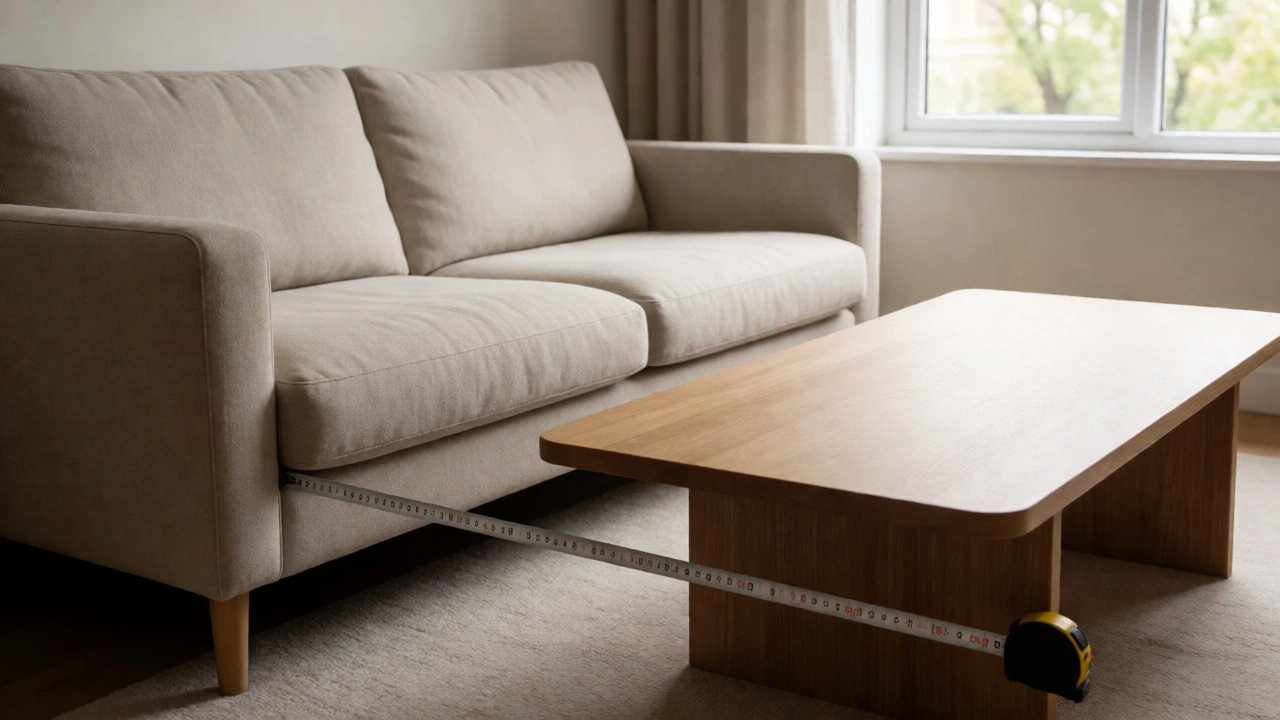
Before you even think about style, grab a tape measure. This isn’t optional; it’s the difference between a functional room and a cramped nightmare. The most common mistake I see in Auckland homes-and honestly, everywhere else-is ignoring clearance zones.
Here is the non-negotiable math:
- Distance from Sofa: Leave 14 to 18 inches (35-45 cm) between the front of your sofa and the edge of the table. Why? Because 14 inches is close enough to set down a mug without stretching, but 18 inches gives you legroom so you aren’t kneeing someone across the way.
- Walkway Width: If people need to walk between the sofa and the TV stand or another chair, ensure there are at least 30 inches (76 cm) of clear path. Anything less than 24 inches feels like squeezing through a turnstile.
- Table Height: Your table should be no higher than the seat cushion of your sofa. Ideally, it’s 1-2 inches lower. If your sofa seats are 18 inches high, look for a table around 16-17 inches tall. A table that towers over your sofa blocks sightlines and makes reaching things awkward.
If you ignore these numbers, you’ll end up with a beautiful piece of furniture that nobody uses because it’s too hard to reach or too easy to trip over.
Center Stage: The Classic Layout
For most rectangular living rooms with a standard sofa facing a TV, centering the table is still the king. But "centered" doesn’t mean just eyeballing it. You want visual balance.
Imagine a line running down the middle of your sofa. Your table should align with this axis. If you have two sofas facing each other, the table sits exactly midway between them. This creates symmetry, which our brains find calming. It also ensures everyone has equal access to snacks and remotes.
However, don’t center it relative to the rug if the rug is too small. A common error is placing a large table on a tiny rug. The rule here is simple: all four legs of the coffee table must sit on the rug, or at least the front two legs should touch it. If the table floats off the rug entirely, it looks disconnected, like it’s drifting away from the conversation area.
Breaking the Grid: Asymmetrical Arrangements
Not every room is a perfect rectangle, and not every family lives symmetrically. Maybe you have an L-shaped sectional. Maybe you prefer a more casual, eclectic vibe. In these cases, ditch the dead-center approach.
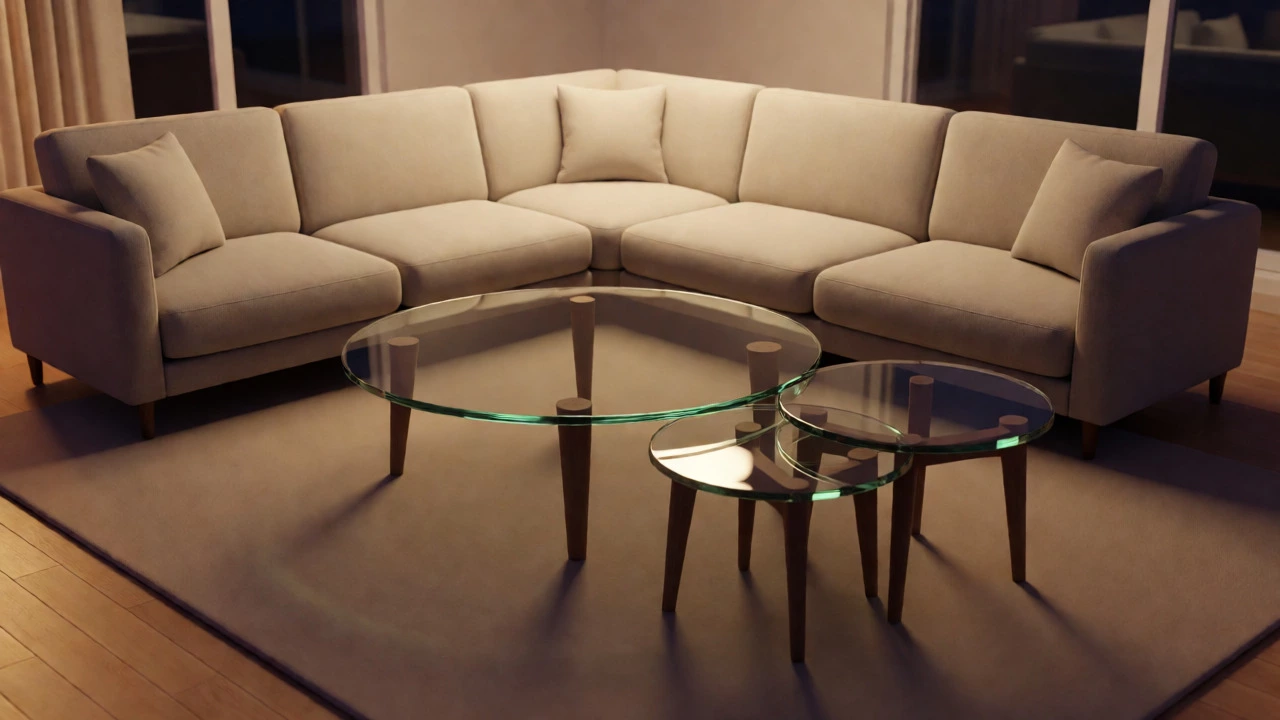
With an L-shaped sectional, avoid pushing the table into the corner. Instead, float it slightly toward the open side of the "L." This keeps the main traffic flow clear while keeping the table accessible to people sitting on both sections. Use a round or oval table here. Sharp corners on a square table near the curve of a sectional are just waiting to bruise shins.
If you’re using multiple smaller tables instead of one big one-say, two nesting tables or a pair of side-by-side stools-you can stagger them. Place one closer to the main seating and the other slightly further back to create depth. This works great in long, narrow rooms where a single wide table would block the view.
Flow and Traffic Patterns
Think about how you actually use the room. Do you carry laundry through here? Does the dog run past constantly? Is there a doorway nearby?
Your coffee table shouldn’t interrupt natural pathways. Stand at the entrance to your living room and walk to the kitchen or hallway. Did you have to sidestep the table? If yes, move it. The table belongs in the "conversation zone," not the "transit zone."
| Zone | Minimum Clearance | Ideal Comfort Level | Why It Matters |
|---|---|---|---|
| Sofa to Table | 12 inches (30 cm) | 14-18 inches (35-45 cm) | Allows legroom while keeping drinks within arm's reach. |
| Main Walkway | 24 inches (60 cm) | 30+ inches (76+ cm) | Prevents bumping into furniture when passing through. |
| Secondary Path | 18 inches (45 cm) | 24 inches (60 cm) | Enough space for a person to squeeze past comfortably. |
| Rug Overlap | Front legs only | All legs on rug | Anchors the furniture group visually. |
Material and Shape Impact Placement
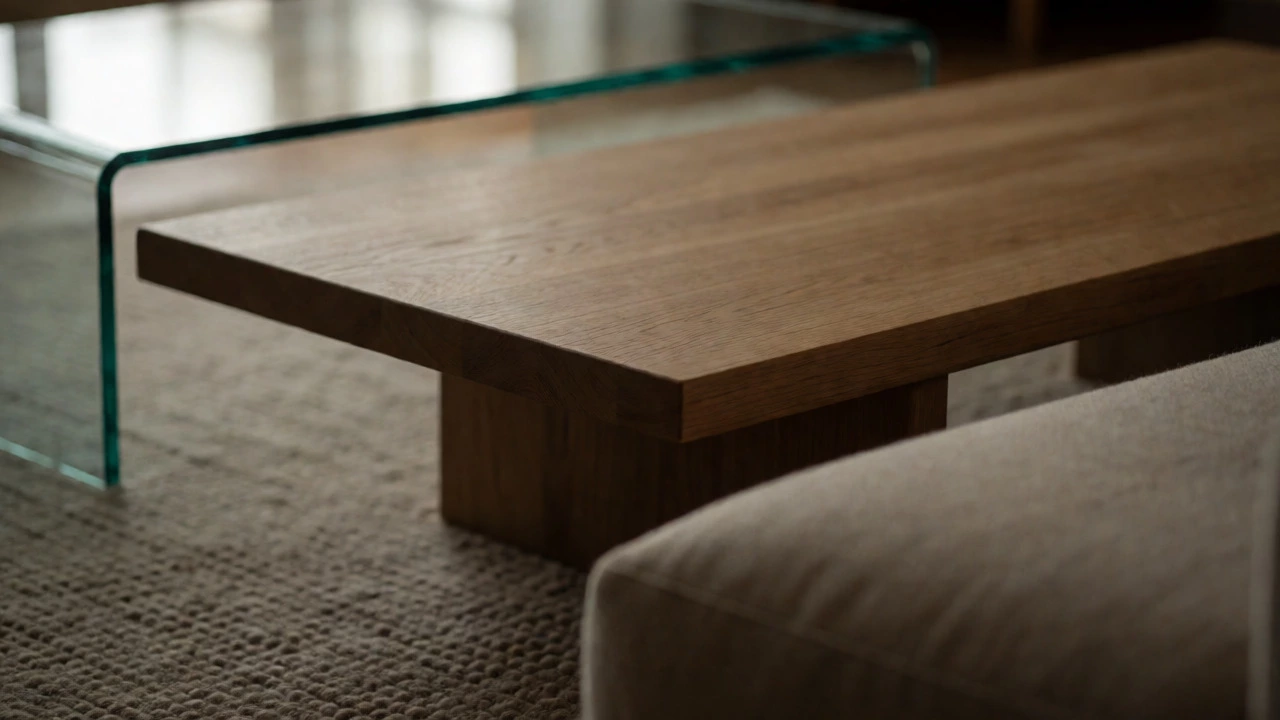
The physical attributes of your table change where it fits best. A glass-top table disappears visually, making it ideal for small apartments where you want to maintain light and openness. You can push it slightly closer to the sofa because it doesn’t feel as bulky.
Conversely, a heavy wooden or stone table demands respect. It needs breathing room. If you cram a massive oak slab into a tight corner, the room will feel suffocating. Round tables are forgiving in tight spaces because they lack sharp edges, allowing you to tuck them into odd angles without creating tripping hazards.
Consider storage too. If your table has drawers or shelves underneath, make sure those aren’t blocked by thick rug piles or low-hanging ottomans. Functionality beats aesthetics if you can’t actually open the drawer.
Troubleshooting Common Layout Nightmares
So, you’ve measured, you’ve placed it, and something still feels off. Here are quick fixes for frequent issues:
- Too Close: If you keep kicking the table, add a slim console table behind the sofa instead. Move the coffee table forward 2 inches. Sometimes that tiny shift solves everything.
- Too Far: If you’re straining to reach your remote, swap your current table for a smaller one or use a tray to bring items closer. Don’t just drag the whole thing forward if it blocks the walkway.
- Visual Clutter: If the table looks messy, it’s likely because it’s too large for the surface area. Clear off 50% of what’s on it. Then, if it still feels crowded, the table is physically too big for the room. Scale down.
Placement isn’t a one-time decision. Seasons change, families grow, and habits shift. Re-evaluate your setup once a year. You might find that moving the table just six inches changes the entire energy of your living room.
How far should a coffee table be from a sectional sofa?
Maintain 14 to 18 inches of clearance from the nearest seating point. For L-shaped sectionals, position the table centrally within the open angle of the 'L' rather than deep in the corner, ensuring all seated guests can reach it without twisting uncomfortably.
Should a coffee table match the rug size?
No, but it should relate to it. Ideally, all four legs of the coffee table rest on the rug. If the rug is smaller, at minimum, the front two legs should sit on it. This anchors the table and prevents it from looking like it is floating in empty space.
Can I put a coffee table in front of a recliner?
Yes, but check the full extension range of the recliner first. Ensure there is enough clearance when the footrest is fully extended so the table does not hit your feet or the mechanism. A smaller, lighter table is often better for recliner setups to allow easy repositioning.
What shape coffee table is best for small rooms?
Round or oval tables are generally best for small rooms because they eliminate sharp corners that can cause bumps and bruises. They also improve traffic flow by allowing people to walk around them more easily than square or rectangular tables.
How high should my coffee table be?
The top of the coffee table should be level with or slightly lower than the seat cushions of your sofa. Typically, this means a height of 16 to 18 inches. A table that is higher than the sofa arms can obstruct views and feel intrusive.