Corner Sofa Suitability Calculator
Enter your room dimensions and preferred sofa size to determine if a corner sofa will work in your space.
Walk into a cramped Auckland apartment or a cozy London flat, and you might feel the urge to maximize every inch of floor space. A corner sofa seems like the obvious answer. It looks big, it holds four people, and it fills that awkward empty corner. But here is the catch: in a small living room, a standard L-shaped sofa can actually make your space feel smaller, cluttered, and harder to navigate.
The question isn't just about whether a corner sofa fits physically. It's about whether it works functionally and aesthetically. If you buy the wrong shape, you'll end up with a room that feels blocked off, where traffic flow is interrupted, and where the furniture dominates rather than complements the space. Let’s break down exactly when a corner sofa makes sense for small rooms and when you should look elsewhere.
Understanding the Geometry of Small Spaces
Before we talk about fabric or color, we need to talk about geometry. A Corner sofa is a piece of furniture designed to fit into a room's corner, typically forming an L-shape. In design terms, this is often called an L-shaped sectional. The problem with L-shapes in small rooms is that they create a solid block of visual weight. Unlike a straight sofa with separate armchairs, which allows light and sightlines to pass through, an L-shape creates a barrier.
Think about how you move through your living room. Do you walk from the kitchen to the front door? From the hallway to the bedroom? If your corner sofa sits in the middle of these paths, it becomes an obstacle. In a small room, every square meter counts. An L-shaped sofa usually requires a minimum width of 180cm to 220cm per side to be comfortable. That’s nearly two meters of floor space consumed by one piece of furniture. In a room that is only 3 meters wide, that leaves very little room for a coffee table, a rug, or breathing room.
Furthermore, the 'chaise' part of the L-shape-the extended section where you stretch out-often sticks out into the room. This protrusion can disrupt the natural flow of the space. If your living room is narrow rather than square, an L-shape can cut the room in half, making both sections feel tiny and disconnected.
When a Corner Sofa Actually Works
Does this mean you should banish all corner sofas from small homes? Not necessarily. There are specific scenarios where an L-shaped sofa is not just acceptable, but ideal. The key lies in the type of corner sofa and the layout of your room.
- The Reversible Chaise: Look for models where the chaise can be placed on either the left or right side. This flexibility allows you to orient the sofa away from high-traffic areas. For example, if your TV is on the short wall, place the chaise on the opposite side to avoid blocking the view or the path to the window.
- Compact Dimensions: Not all corner sofas are giants. Many manufacturers now produce 'compact' or 'apartment-sized' L-shaped sofas. These might have a total width of 160cm instead of the standard 200cm+. Always measure your space before buying. Leave at least 60cm of walking space around the sofa.
- Open-Plan Living: If your living room flows directly into a dining area or kitchen, a corner sofa can act as a subtle divider. It defines the 'living zone' without needing a physical wall. In this case, choose a low-back model so sightlines remain open across the room.
- Square Rooms: If your small living room is roughly square (e.g., 4m x 4m), a corner sofa fits naturally into the geometry. It utilizes the dead space in the corner efficiently, leaving the center of the room open for other activities.
If your room is long and narrow, however, stick to a straight sofa. An L-shape will likely choke the space.
The Visual Tricks: Making It Feel Bigger
If you decide a corner sofa is right for you, the next challenge is ensuring it doesn't overwhelm the room. Design psychology plays a huge role here. We perceive spaces as larger when they feel light, airy, and uncluttered. Here is how to achieve that with a bulky piece of furniture.
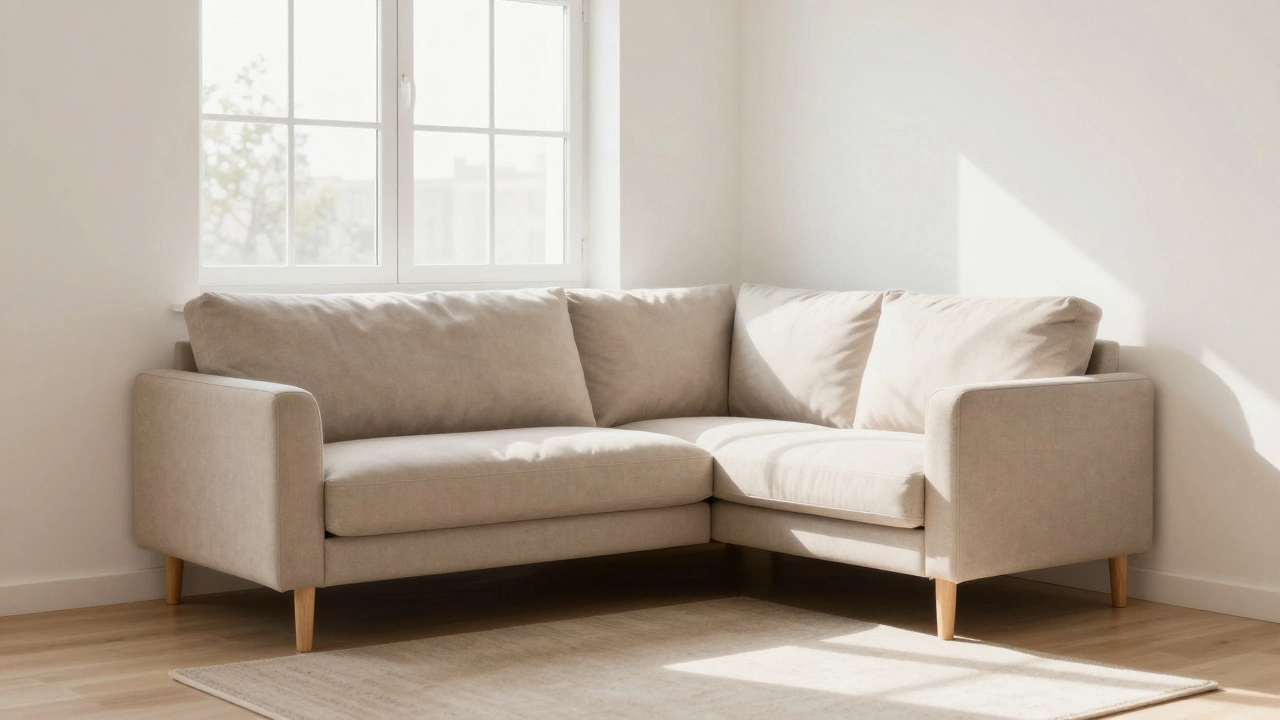
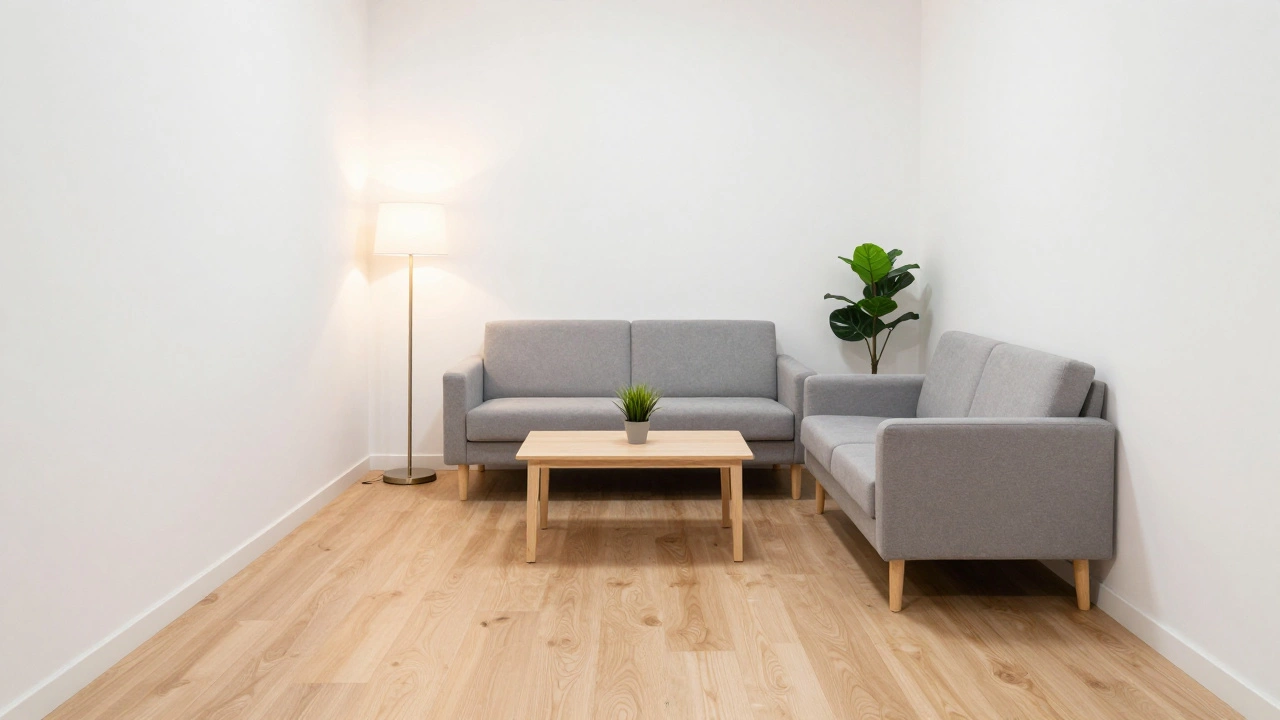
Legs are your best friend. Choose a corner sofa with raised legs. When the base of the sofa is visible, your eye sees the floor continuing underneath it. This creates an illusion of depth and lightness. Avoid 'plinth' bases, where the sofa sits flush against the floor. Those heavy, boxy designs anchor the furniture to the ground and make the room feel heavier. A sofa on slender wooden or metal legs feels like it’s floating, which reduces its visual mass.
Color matters more than you think. Dark colors absorb light; light colors reflect it. In a small living room, a light grey, beige, or soft white corner sofa will recede into the background, making the walls appear further away. If you love dark colors, consider a lighter frame with darker cushions, or use throw pillows to add contrast without committing to a full dark upholstery job. Pattern can also help. A subtle geometric pattern can break up the large surface area of the sofa, preventing it from looking like a monolithic block.
Keep the back low. High-back sofas block views and light. In a small room, you want to maintain sightlines to windows and doors. A low-back corner sofa allows light to travel deeper into the room and lets you see across the space, enhancing the feeling of openness.
Alternatives to Consider
Sometimes, the best way to solve a small space problem is to rethink the furniture entirely. If a corner sofa feels too risky, what are your options?
| Furniture Type | Space Efficiency | Seating Capacity | Best For |
|---|---|---|---|
| Straight Sofa + Armchair | High | 3-4 people | Narrow rooms, flexible layouts |
| L-Shaped Corner Sofa | Medium | 4-5 people | Square rooms, open-plan spaces |
| Loveseat | Very High | 2 people | Studio apartments, minimalist styles |
| Modular Sofa | Variable | Customizable | Changing needs, unique room shapes |
A Straight sofa paired with a single armchair is often the superior choice for small, narrow living rooms. It provides similar seating capacity to a corner sofa but allows you to angle the chair slightly, creating a conversational nook without blocking pathways. You can also move the armchair when guests arrive, adding flexibility that a fixed L-shape lacks.
Another excellent option is a Modular sofa system. These allow you to start with a simple two-seater and add pieces later. While they can grow into large L-shapes, you have the control to keep them compact. Some modular systems even include ottomans that double as coffee tables or extra seating, maximizing utility in a small footprint.
Practical Tips for Buying and Placement
Buying furniture online or even in-store can be deceptive regarding size. Here is a checklist to ensure your corner sofa works in your specific environment.
- Measure the Doorway and Hallways: This is the most common mistake. A corner sofa might fit in the room, but can it get there? Measure the width and height of your front door, any interior doors, and tight corners in hallways. Disassembling a sofa is difficult and expensive. If it won’t fit through the door, it won’t fit in the room.
- Use Painter’s Tape: Before you buy, go home and use painter’s tape to mark the exact dimensions of the sofa on your floor. Live with those outlines for a day. Walk around them. Sit on the floor where the coffee table would go. Does it feel cramped? Do you bump into things? This tactile test reveals issues that measurements alone miss.
- Check the Depth: Standard sofa depths are around 90-100cm. In a small room, a shallower depth (75-85cm) can make a significant difference. It leaves more room for circulation and makes the room feel less crowded.
- Consider Storage: If you live in a small apartment, storage is premium. Look for corner sofas with built-in storage compartments under the seats. This can replace the need for a separate chest or cabinet, reducing overall clutter.
- Lighting Balance: Ensure your corner sofa doesn’t block natural light sources. If it does, compensate with layered artificial lighting-floor lamps, table lamps, and ceiling lights-to keep the room bright and welcoming.
Final Thoughts on Comfort vs. Space
Ultimately, the decision comes down to your lifestyle. Do you entertain often? Do you need a place to nap during the day? If yes, the extra seating and lounging space of a corner sofa might be worth the spatial trade-off. But if you value open, airy spaces and minimalism, a smaller straight sofa or loveseat will serve you better.
Remember, furniture should serve you, not dominate your home. A well-chosen corner sofa can be the heart of a small living room, providing comfort and style. But a poorly chosen one can turn your sanctuary into a maze. Take your time, measure twice, and prioritize flow over sheer seating capacity.
What is the ideal size for a corner sofa in a small living room?
For a small living room, look for a compact corner sofa with a total width of no more than 180cm (approx. 71 inches). Ideally, each side of the 'L' should be between 150cm and 180cm. This ensures you leave at least 60cm of walking space around the furniture, maintaining good traffic flow.
Can I put a corner sofa in a narrow living room?
It is generally not recommended. Narrow living rooms benefit from straight sofas that run parallel to the longest wall. An L-shaped sofa in a narrow room blocks pathways and makes the space feel even tighter. If you must have an L-shape, ensure the chaise is on the shorter side of the room to minimize obstruction.
How do I make a corner sofa look smaller in a small room?
Choose a sofa with raised legs to show more floor space. Opt for light colors like beige, grey, or white to reflect light. Select a low-back design to maintain sightlines. Finally, keep the surrounding area clutter-free and use a rug that fits under the front legs of the sofa to define the space without overwhelming it.
Is an L-shaped sofa better than a regular sofa for small spaces?
Not necessarily. While an L-shaped sofa offers more seating, it takes up more floor space. For small, narrow rooms, a regular straight sofa with an armchair is often better because it allows for more flexible arrangement and better traffic flow. L-shaped sofas work best in square or open-plan small rooms.
What is the difference between a corner sofa and a sectional?
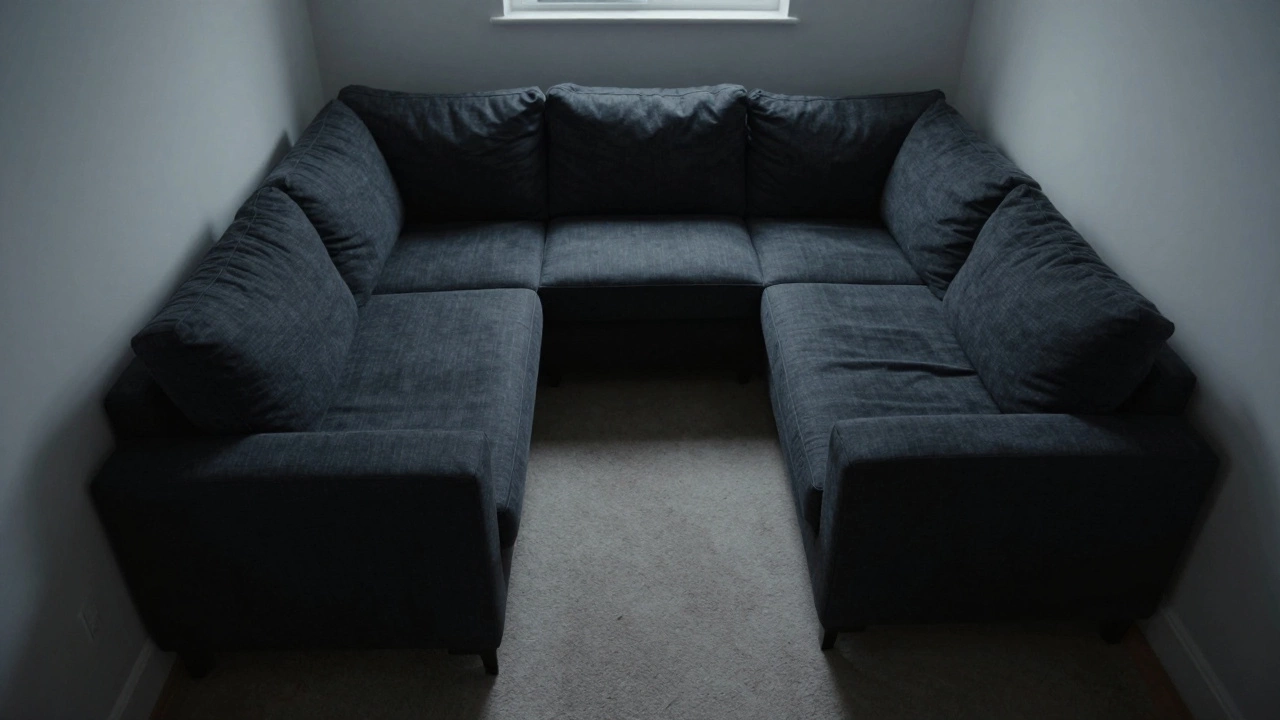
In many regions, these terms are used interchangeably. However, technically, a corner sofa usually refers specifically to an L-shaped configuration. A sectional can be L-shaped, U-shaped, or modular. For small living rooms, stick to simple L-shaped configurations rather than complex U-shaped sectionals, which require significantly more space.
Should I choose a reversible corner sofa?
Yes, highly recommended. A reversible corner sofa allows you to switch the chaise lounge from the left to the right side. This flexibility is crucial in small rooms where you may need to adjust the layout to accommodate TV placement, door swings, or window access. It future-proofs your purchase if you move or rearrange your furniture.