Coffee Table Tray Size & Style Calculator
You’ve just bought that beautiful round coffee table, and now you’re staring at its smooth, unbroken surface wondering what to do with it. Do you leave it bare? Stack books haphazardly? Or does it need a matching circular tray to tie the look together? It’s a common dilemma in modern living rooms. On one hand, symmetry feels satisfying. On the other, it can feel like you’re decorating by formula rather than intuition.
The short answer is: no, a round coffee table doesn’t *have* to have a round tray. In fact, relying solely on circular shapes can make your space feel monotonous or overly staged. The real goal isn’t matching shapes for the sake of it-it’s creating visual interest, functionality, and balance. Let’s break down why mixing shapes often works better than sticking to circles, and how to style your table so it looks intentional, not accidental.
Why We Crave Symmetry (And Why It Can Backfire)
Humans are wired to find comfort in patterns. When we see repeating shapes, our brains register order and calm. That’s why a round tray on a round table feels ‘right’ at first glance. It creates a clean, minimalist line that draws the eye inward without distraction.
But here’s the catch: too much uniformity kills energy. If your coffee table is round, your rug is round, your tray is round, and even your throw pillows are circular… well, you start looking less like a curated home and more like a geometry textbook. Interior designers often warn against this ‘shape echo.’ Without contrast, the eye has nowhere to rest, and the space can feel flat or sterile.
Think about it: would you wear an outfit where every piece was the exact same cut and color? Probably not. You’d want texture, variation, and maybe a pop of something unexpected. Your living room deserves the same treatment.
The Power of Contrast: Mixing Shapes for Visual Interest
This is where things get fun. Instead of defaulting to a round tray, consider introducing angular or organic shapes to create tension and depth. A rectangular wooden tray, for example, adds structure and grounding to a soft, curved table. It breaks up the curve and gives your arrangement a sense of direction.
- Rectangular trays: Add stability and sophistication. Great for holding magazines, remotes, or a small vase.
- Square trays: Offer a modern, geometric counterpoint. Ideal for minimalist or Scandinavian-style spaces.
- Oval trays: Soften the angle while still breaking the perfect circle. Perfect if you want subtlety over drama.
- Organic-shaped trays: Think irregular stone, asymmetrical wood, or hand-blown glass. These add personality and artisanal charm.
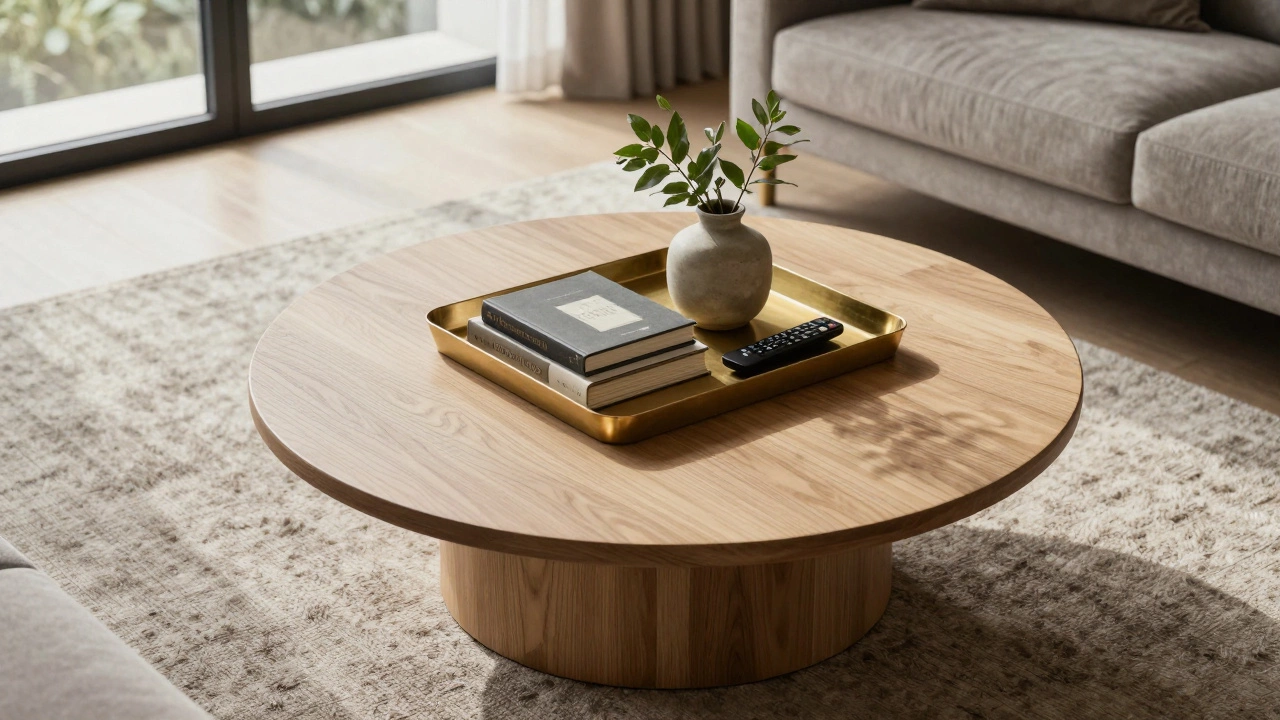
Mixing shapes doesn’t mean chaos. It means intention. Place a rectangular tray slightly off-center on your round table, then layer in a stack of hardcover books, a small ceramic bowl, and a trailing plant. Suddenly, your table tells a story instead of just sitting there.
Functionality Over Form: What Do You Actually Need?
Let’s talk practicality. A coffee table isn’t just decor-it’s a workspace, a snack station, a remote holder, and sometimes a makeshift desk. So ask yourself: what do I actually use my table for?
If you’re someone who constantly loses their phone keys or needs a place to set down a mug without risking spills, a tray-any shape-is incredibly useful. It contains clutter and makes cleaning easier. But if you prefer a sparse, open look and rarely use the table for anything beyond occasional decor, skip the tray altogether.
Consider these scenarios:
| Scenario | Best Tray Shape | Why It Works |
|---|---|---|
| Daily clutter control | Rectangular or square | Easy to slide items in/out; fits standard objects like phones and remotes |
| Decorative display only | Round or oval | Blends seamlessly with table; highlights centerpiece like a candle or sculpture |
| Entertaining guests | Large rectangular or oval | Holds multiple drinks/snacks; encourages sharing and conversation |
| Minimalist aesthetic | No tray | Keeps surface clear; emphasizes negative space and simplicity |
Don’t force a tray into your life if it doesn’t serve a purpose. Decor should enhance your daily routine, not complicate it.
Material Matters: Texture Adds Depth
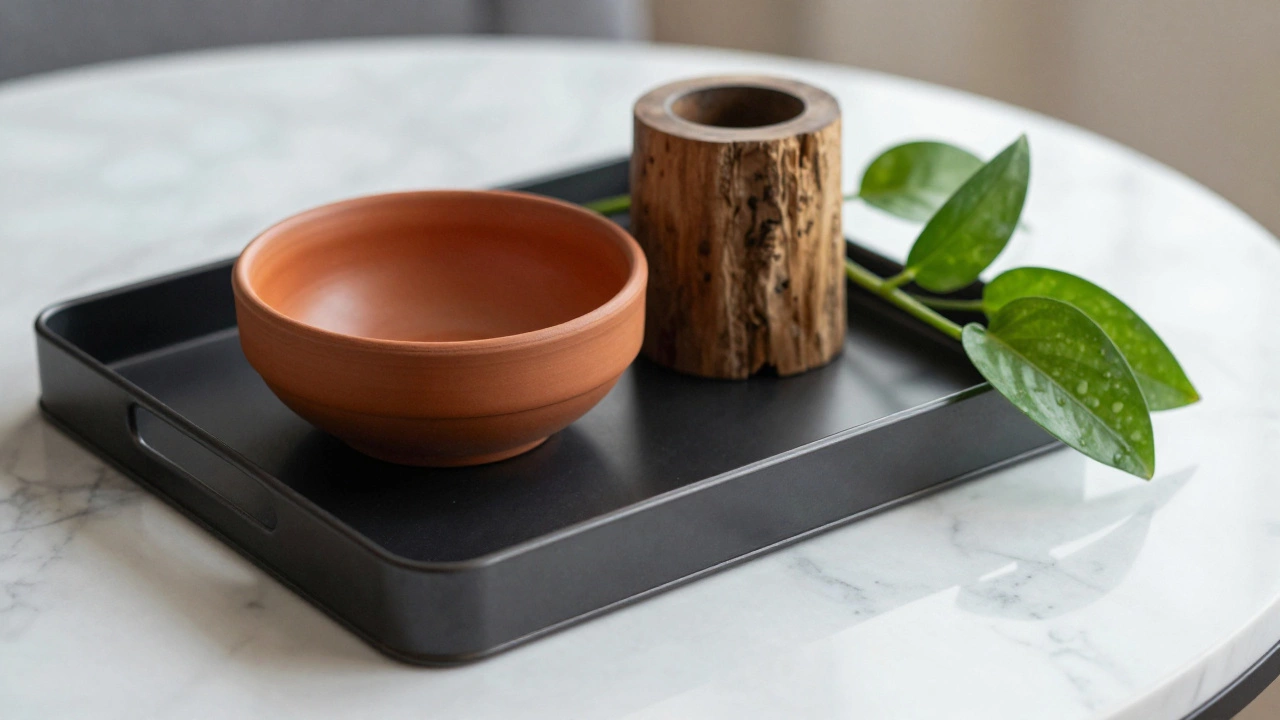
Shape isn’t the only variable playing here. Material choice dramatically affects how your table feels. A glossy lacquered round table paired with a matte black metal tray creates instant contrast-not just in shape, but in finish and weight.
Try combining different textures:
- Wood + Metal: Warmth meets industrial edge. Try a light oak table with a brushed brass tray.
- Glass + Ceramic: Transparency pairs beautifully with earthy tones. A glass-top table with a terracotta tray feels airy yet grounded.
- Stone + Fabric: Heavy marble table softened by a woven jute or linen-covered tray base.
Texture invites touch. People naturally want to run their fingers over rough surfaces or feel the coolness of polished stone. By varying materials, you engage more senses and make your space feel alive.
Scale and Proportion: Don’t Crowd the Surface
One mistake people make is choosing a tray that’s too big-or too small-for their table. As a rule of thumb, your tray should cover no more than two-thirds of the table’s diameter. Anything larger overwhelms the space; anything smaller disappears visually.
For a 36-inch round table, aim for a tray around 24-28 inches. For a 48-inch table, go up to 32-36 inches. Leave breathing room around the edges. Negative space is your friend-it lets each element shine without competing for attention.
Also consider height. Layering items vertically (books under a tray, a tall vase beside a low bowl) adds dimension without taking up floor space. Just ensure nothing blocks sightlines across the room.
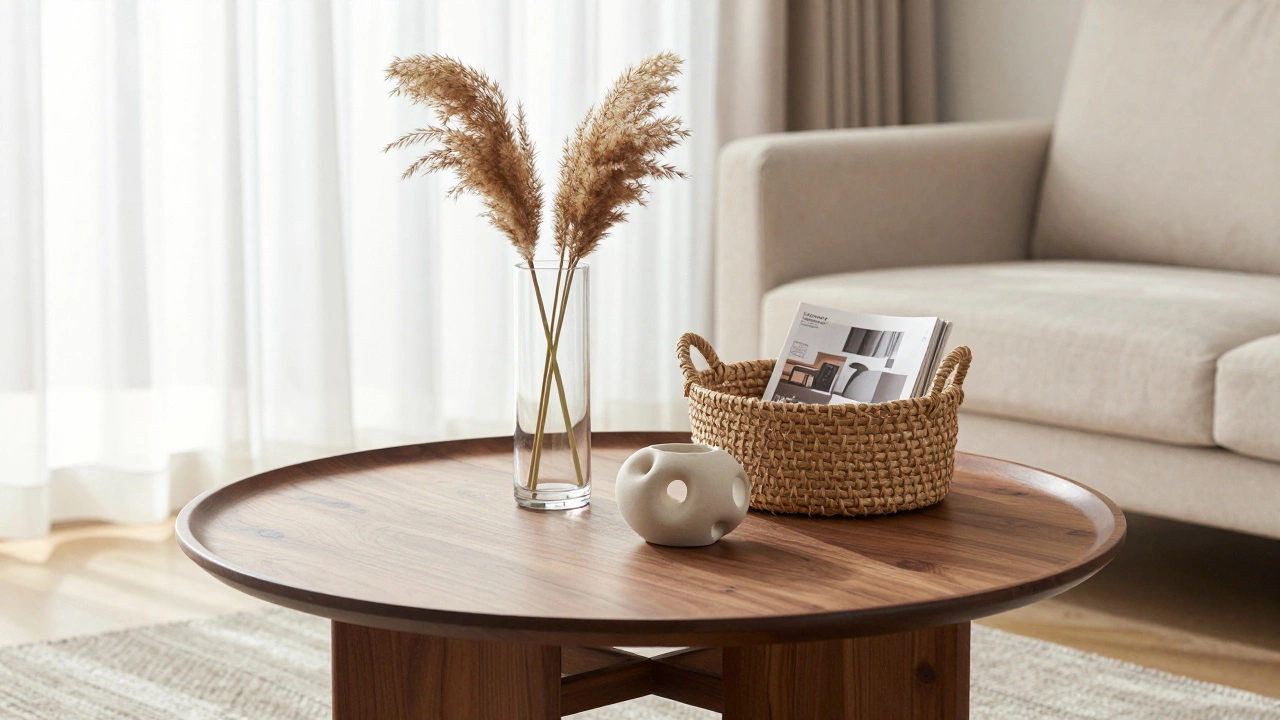
When a Round Tray Actually Makes Sense
There are exceptions, of course. Sometimes, a round tray is exactly what your space needs. Here’s when it shines:
- Small tables: If your table is under 30 inches, a large tray might dominate. A smaller round tray keeps proportions balanced.
- Bohemian or eclectic styles: Where mismatched elements thrive, a round wicker or rattan tray adds warmth and whimsy.
- Centerpiece focus: If you’re displaying a single statement object-a large crystal, a sculptural bowl, or a potted succulent-a round tray frames it perfectly.
- Kids or pets: Rounded edges reduce injury risk. A low-profile round tray also prevents tipping hazards.
In these cases, the round tray isn’t following a rule-it’s solving a problem. And that’s always a good reason to keep it.
Styling Tips That Work Every Time
No matter which shape you choose, follow these simple principles to elevate your coffee table styling:
- Odd numbers win: Group items in threes or fives. One vase, three candles, five stacked books. Odd groupings feel natural and dynamic.
- Vary heights: Use risers, stacks, or tiered stands to create vertical movement. Flat arrangements bore the eye.
- Add greenery: Even a small trailing pothos or air plant brings life and softens hard lines.
- Rotate seasonally: Swap out colors, textures, and objects with the seasons. Spring gets pastels and florals; winter gets rich woods and metallics.
- Leave some empty space: Not every inch needs filling. Empty areas give your eyes a place to rest and prevent visual fatigue.
Remember: your coffee table reflects your lifestyle. If you love hosting dinner parties, lean toward functional trays that hold snacks and drinks. If you’re a bookworm, let your favorite reads take center stage. There’s no right way-only your way.
Final Thoughts: Trust Your Eye, Not the Rulebook
So, should a round coffee table have a round tray? Only if it serves your needs and enhances your space. Don’t fall into the trap of thinking symmetry equals beauty. Often, it’s the opposite. Contrast, variety, and thoughtful imperfection are what make interiors feel lived-in and inviting.
Experiment. Move things around. Take photos from above to check balance. Step back and ask: does this feel like me? If yes, you’ve nailed it. If not, tweak until it does.
Your home shouldn’t look like a showroom. It should look like yours. And that starts with making choices that reflect your personality-not just following trends.
Can I use a square tray on a round coffee table?
Absolutely! A square tray adds geometric contrast and visual interest. It grounds the soft curves of a round table and creates a modern, balanced look. Just ensure the tray isn’t too large-aim for covering no more than two-thirds of the table’s surface.
What size tray should I get for a 36-inch round coffee table?
For a 36-inch round table, choose a tray between 24 and 28 inches in diameter (or equivalent width for rectangular/square trays). This leaves enough negative space around the edges to avoid crowding while still anchoring your decor.
Is it okay to not use a tray at all?
Yes! Many stylish homes skip trays entirely, especially if they prefer minimalism or don’t need extra storage. Focus on arranging decorative objects directly on the table using odd-numbered groupings and varied heights for visual appeal.
How do I style a coffee table for entertaining?
Use a large rectangular or oval tray to hold drinks, snacks, and coasters. Add a small bowl for nuts or chocolates, a few napkins, and perhaps a candle for ambiance. Keep essentials like remotes tucked away in a hidden compartment or separate caddy.
What materials pair well with a wooden round coffee table?
Wood pairs beautifully with metal (brass, iron), ceramic, glass, and natural fibers like jute or rattan. Mix finishes-matte wood with shiny metal, for example-to add depth and prevent monotony.