TV Height Calculator
Find the perfect spot for your TV. Enter your details to calculate the recommended bottom-edge height from the floor.
Recommended Placement
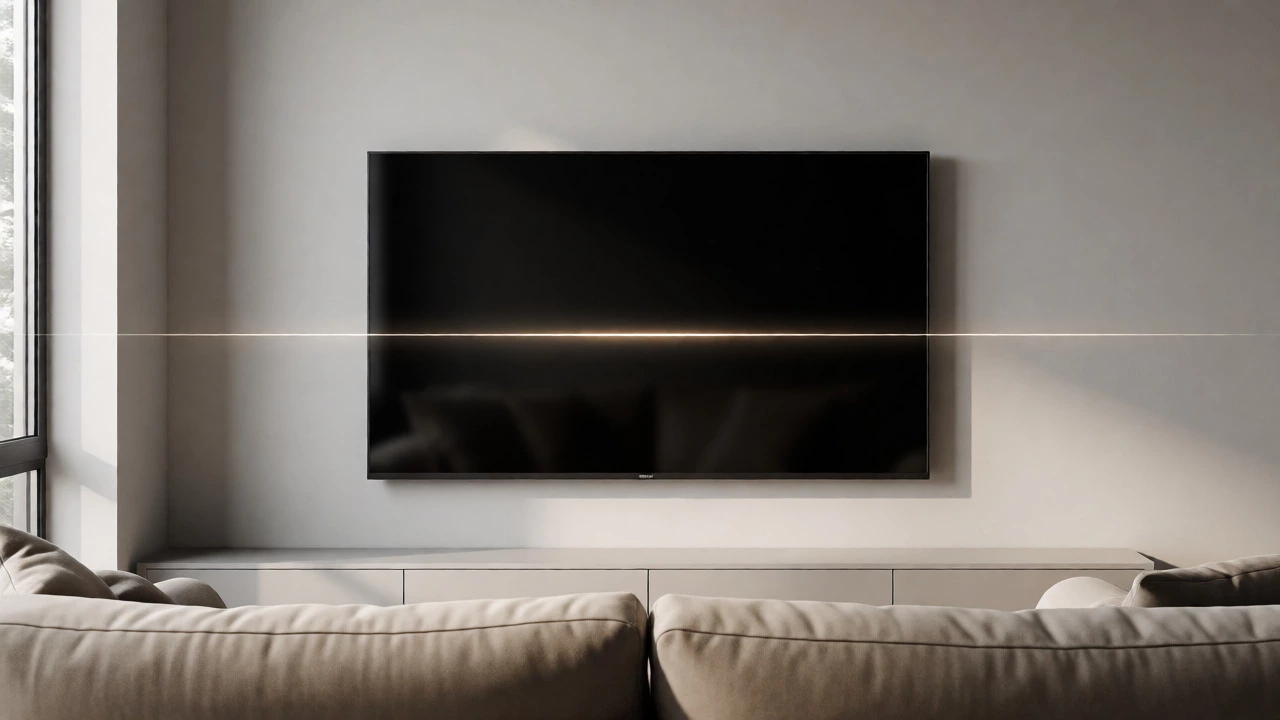
Visual Guide
*Visual representation is approximate. The red line indicates your inputted eye level. The TV moves to align its center with this line.*
You just bought a massive 65-inch screen. It’s sleek, it’s bright, and it’s currently sitting in its box, mocking you with the question: where exactly do I put this thing?
Getting the height wrong is one of those home improvement mistakes that doesn’t scream at you immediately. Instead, it whispers. A week later, your neck starts to ache after an hour of Netflix. A month later, you realize the glare from the window makes the top third of the screen useless. You didn't buy a theater experience; you bought a crick in your neck.
The answer isn't a single number etched in stone. It depends on where you sit, how tall you are, and whether you're mounting it or resting it on a TV stand. But there is a golden rule, a mathematical sweet spot that works for 90% of living rooms. Here is how to find it for your specific setup.
The Golden Rule: Eye Level is King
Forget the floor. Forget the ceiling. The most important measurement in your room is the height of your eyes when you are seated comfortably on your sofa. That is your anchor point.
According to general ergonomic standards and recommendations from bodies like the Society of Motion Picture and Television Engineers (SMPTE), the center of your TV screen should be at or slightly below your eye level while seated. Why slightly below? Because looking down is less taxing on the neck muscles than looking up. If your eyes are dead-center with the middle of the screen, you’re good. If the center is above your eyes, you’re tilting your head back. Bad idea for marathon viewing sessions.
For the average adult, seated eye level is typically between 42 and 48 inches from the floor. This varies based on your height and your sofa’s seat depth, but it’s a reliable starting block.
Calculating the Height for a 65-Inch TV
A 65-inch TV refers to the diagonal measurement of the screen, not the height. To figure out the physical dimensions, we need to do some quick geometry. Most modern TVs have a 16:9 aspect ratio.
- Diagonal: 65 inches
- Actual Screen Height: Approximately 31.9 inches
- Actual Screen Width: Approximately 56.7 inches
Now, let’s look at the bezel (the frame around the screen). Modern TVs have thin bezels, adding maybe half an inch to the total height. So, the total physical height of the TV unit itself is roughly 32.5 inches.
If you want the center of the screen to be at 42 inches (a common seated eye level), here is the math:
- Take the target eye level: 42 inches.
- Subtract half the TV's height: 32.5 / 2 = 16.25 inches.
- Result: 42 - 16.25 = 25.75 inches.
This means the bottom edge of your 65-inch TV should be approximately 25 to 26 inches off the floor if you are placing it on a stand or mounting it low. If you are taller, or sit on a high-backed armchair, adjust the base number up. If you are shorter, or sit on a deep, sunken sectional, adjust it down.
TV Stand vs. Wall Mount: Different Rules Apply
How you install the TV changes the constraints significantly.
| Installation Method | Typical Bottom Edge Height | Best For |
|---|---|---|
| On a Standard TV Stand | 20-26 inches | Rental properties, frequent reconfiguration, hiding cables easily. |
| Fixed Wall Mount | 26-30 inches | Permanent setups where you can drill into studs. |
| Tilt Wall Mount | 30-36 inches | High placements (above fireplaces) to angle screen downward. |
| Full-Motion Arm | Flexible (24-40+ inches) | Multi-purpose rooms, dining areas, or varying seating angles. |
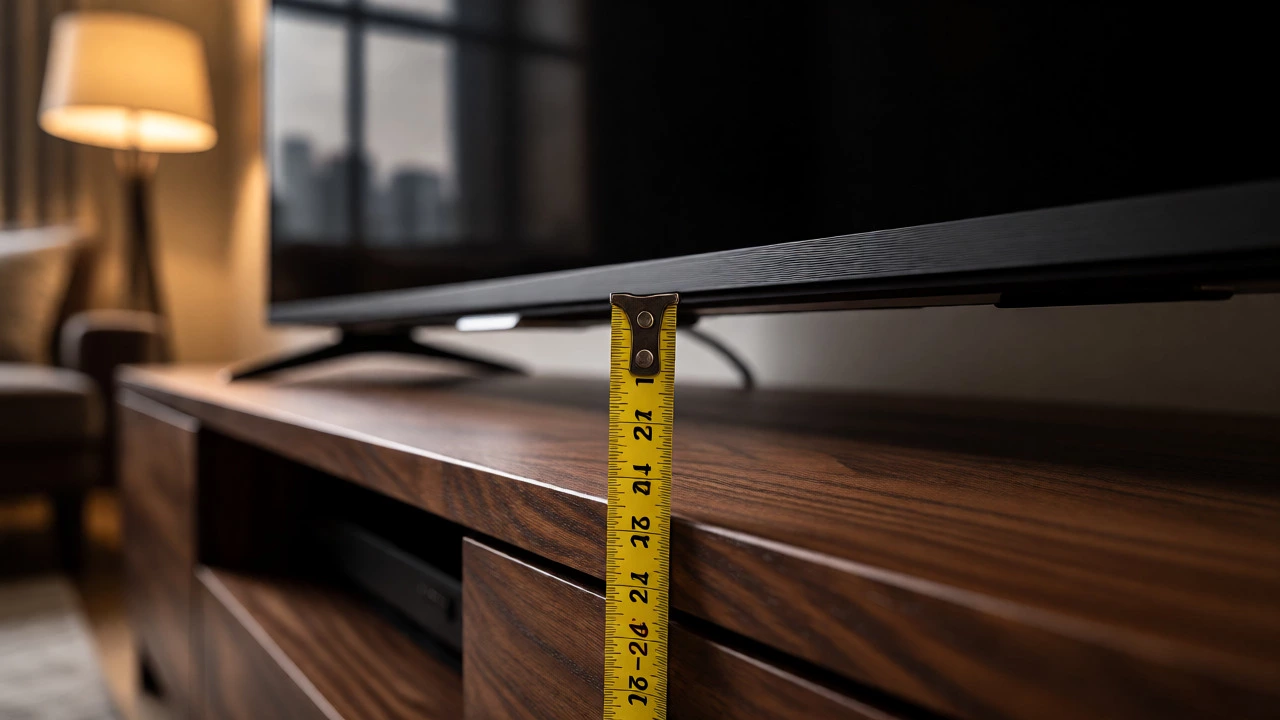
Using a TV Stand: Most standard TV stands are about 20 to 24 inches tall. If you place a 65-inch TV on a 24-inch stand, the bottom of the screen sits at 24 inches. The center of the screen will then be at 24 + 16.25 = 40.25 inches. This is nearly perfect for someone with a seated eye level of 40-42 inches. If your stand is lower (e.g., a media console at 18 inches), the screen center drops to 34 inches. That might feel too low unless you are sitting on a very low-profile sofa.
Wall Mounting: This gives you control. If you mount the bracket so the bottom of the TV is at 26 inches, you hit that ergonomic sweet spot. However, many people make the mistake of mounting the TV too high because they want it centered on the wall space above a fireplace or cabinet. Remember: comfort beats symmetry.
The Fireplace Dilemma: Can You Go Higher?
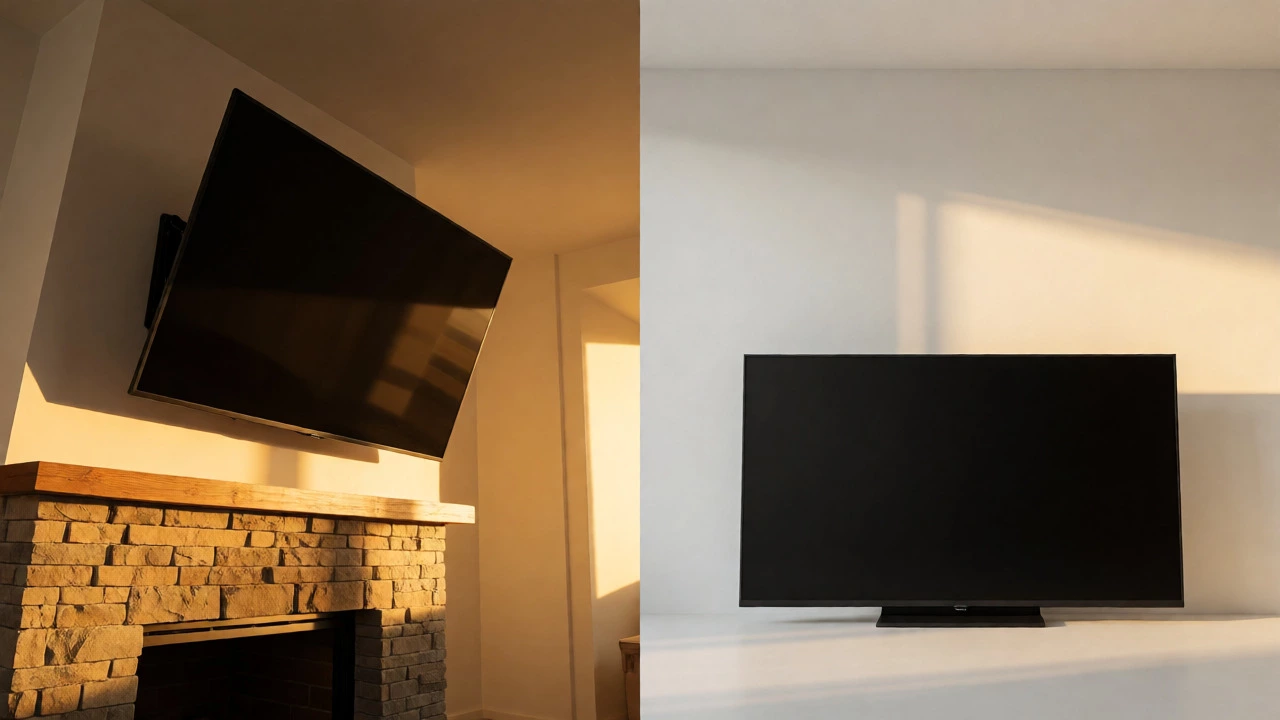
Yes, you can go higher, but you pay a tax in neck strain. In New Zealand, as elsewhere, the fireplace is often the architectural focal point of the living room. Centering the TV above it looks great in photos. But functionally? It’s tricky.
If you must mount a 65-inch TV above a fireplace, aim for a tilt mount. A fixed mount angled upward forces you to look up constantly. A tilt mount allows you to angle the screen down toward your seating area, effectively lowering the "visual" center even if the physical center is high.
Try to keep the bottom of the TV no more than 4-6 inches above the mantel shelf. If the mantel is at 48 inches, the TV bottom would be at 52-54 inches. The center would be around 68-70 inches. That is well above average eye level. You’ll likely find yourself leaning forward or adjusting your posture to see the bottom of the screen clearly during subtitles.
Viewing Distance Matters Too
Height isn't the only variable. How far away you sit affects how much you notice poor positioning. The SMPTE recommends a viewing distance of about 1.6 times the diagonal size of the screen for optimal immersion.
For a 65-inch TV:
- Optimal Viewing Distance: 65 x 1.6 = 104 inches (approx. 8.7 feet).
If you sit closer than 8 feet, errors in height become glaringly obvious. You’ll see pixelation or struggle with the angle. If you sit further back (10+ feet), slight height deviations matter less because the viewing angle flattens out. So, if your living room is large, you have more wiggle room. If it’s cozy, precision matters.
Practical Tips for Getting It Right
Don’t trust the tape measure alone. Your body knows what feels right before your brain calculates it. Here is a foolproof way to test the height before you drill holes or buy furniture.
- The Paper Template Trick: Cut a piece of cardboard or poster board to the exact dimensions of your TV’s screen (approx. 32" x 57"). Tape it to the wall or hold it up against the intended stand location.
- Sit Down: Sit on your actual sofa, in your normal watching position. Have a friend mark the wall at your eye level.
- Align: Move the template so its center aligns with that mark. Step back. Does it feel natural? Does it block light sources? Does it clash with artwork?
- Check Glare: Look at the template from your seat. Are windows reflecting off the top half? If yes, you might need to shift the TV horizontally or use curtains, regardless of height.
Another pro tip: consider cable management. If you’re using a stand, ensure the back panel has cutouts for cables. If you’re wall-mounting, plan for in-wall conduit or raceways. Nothing ruins the sleek look of a perfectly positioned 65-inch TV faster than a spaghetti bowl of HDMI cords dangling from the bottom edge.
Common Mistakes to Avoid
I’ve seen homeowners fall into these traps repeatedly. Avoid them, and you’ll save yourself a headache.
- Mounting to the Ceiling: Unless you’re in a sports bar or a kitchen where you watch from a counter, avoid ceiling mounts for main living room TVs. The angle is brutal on the neck.
- Ignoring Sofa Depth: Deep sectionals push your eyes back. If your sofa is 40 inches deep, your eyes are further from the wall than a standard chair. Recalculate your eye level if you change furniture.
- Centering on the Wall, Not the Room: Walls aren’t always symmetrical. Center the TV relative to your primary seating arrangement, not the architectural wall.
- Forgetting Soundbars: If you plan to use a soundbar, leave 2-4 inches of clearance below the TV. Some stands are designed with shelves specifically for this. Don’t block the speaker drivers.
Final Thoughts on Comfort
There is no universal "correct" height. There is only the correct height for you. Start with the calculation: bottom of the TV around 25-26 inches off the floor for a standard setup. Adjust up if you’re tall, down if you’re short or sit low. Use a tilt mount if you absolutely must go higher for aesthetic reasons.
Your TV should disappear into your lifestyle, not dominate it with discomfort. Take ten minutes to mock it up with cardboard. Your future self, enjoying a movie night without a stiff neck, will thank you.
Is 65 inches too big for a small room?
Not necessarily. While the recommended viewing distance is about 8.7 feet, modern 4K resolution allows you to sit closer without seeing pixels. If you sit 6-7 feet away, a 65-inch TV provides an immersive cinematic experience. Just ensure you have enough horizontal width on your stand or wall to accommodate the 56-inch width of the screen.
Should the TV be centered on the wall or the couch?
Always center the TV on your primary seating arrangement. If your couch is offset from the center of the wall due to a doorway or window, align the TV with the couch. Symmetry with the room architecture is secondary to comfortable viewing angles.
What if my TV stand is too low?
If your stand puts the TV center significantly below eye level, you can raise it. Options include buying risers for the stand legs, placing a decorative box or platform under the TV base, or switching to a wall mount which offers unlimited height flexibility.
Does the type of TV panel affect height choice?
Yes, indirectly. OLED and QLED panels often have wider viewing angles and better contrast than older LCDs. This means you can tolerate slightly off-center viewing positions better. However, vertical viewing angles still matter; looking up at a screen can wash out colors on some panels, reinforcing the need to keep the center at or below eye level.
How high should a 65-inch TV be above a fireplace?
Ideally, keep the bottom of the TV within 4-6 inches of the mantel shelf. If the mantel is high, use a tilt mount to angle the screen down. Never mount a TV directly on a masonry surface without proper insulation and ventilation considerations, as heat can damage electronics over time.